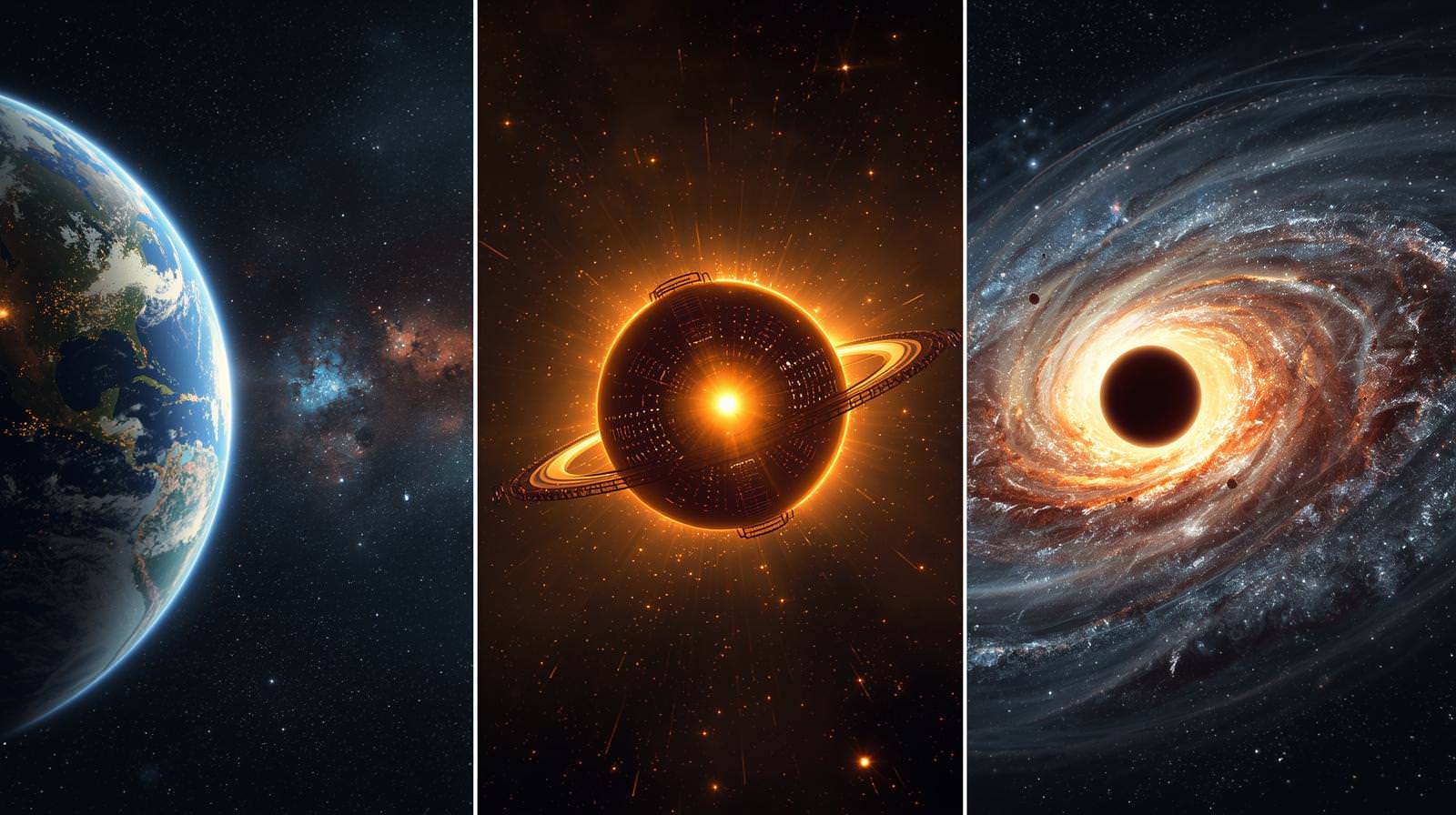
In the vast, silent expanse of the cosmos, a profound question has echoed throughout human history: Are we alone? This question has fueled the Search for Extraterrestrial Intelligence (SETI) for decades, prompting scientists to develop frameworks for conceptualizing what other forms of intelligent life might be like. One of the most influential and enduring ideas in this context is the Kardashev Scale. Proposed in 1964 by Soviet astronomer Nikolai Kardashev, this scale classifies hypothetical extraterrestrial civilizations not based on their biology or culture, but through a metric that is both universal and detectable across interstellar distances: their energy consumption.
The scale operates on an inspiring idea: a civilization's technological progress is closely linked to its mastery of energy. As societies grow and innovate, their energy demands increase, driving them to explore and utilize resources on a massive scale. This evolving journey promises exciting advancements and endless possibilities for the future!
Kardashev proposed that the advancement of civilizations would follow a predictable path, progressing from the ability to utilize resources on their home planet to harnessing energy from a star, and eventually controlling energy at a galactic scale. This article examines the origins of the Kardashev Scale, outlines its three foundational categories; Type I, Type II, and Type III civilizations, and explores its enduring impact on science and our collective imagination.
The Genesis of the Scale: A Cold War Vision for Cosmic Society
The Kardashev Scale originated from the distinct scientific and geopolitical context of the Cold War era. In 1964, while working as part of a Soviet program using radio astronomy to listen for signals from space, Nikolai Kardashev presented his classification system at the Byurakan Conference in the Armenian SSR. His seminal paper, "Transmission of Information by Extraterrestrial Civilizations," was not merely a theoretical exercise; it was intended as a practical guide for SETI researchers. Kardashev reasoned that if highly advanced civilizations existed, their immense energy usage would generate detectable technosignatures, providing a way for humanity to find them.
Kardashev built his model on what he considered immutable physical laws and the axiom of exponential growth, using human civilization as a model for extrapolation. In a 1980 article, he further refined his thinking, defining a civilization functionally as a "highly stable state of matter capable of acquiring, making abstract analysis of, and utilizing information to obtain qualitatively new information about its environment and about itself." This dual focus on energy and information processing formed the bedrock of his scale, providing a tangible metric for a concept as abstract as "advancement."
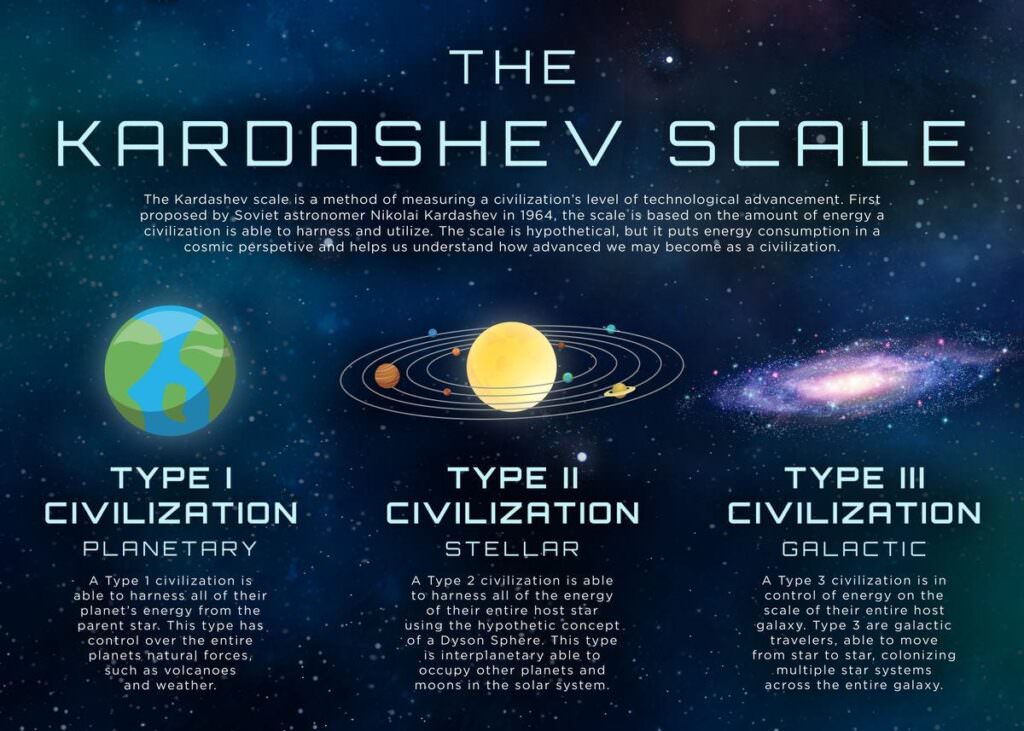
He proposed three distinct tiers, each representing a significant advancement in energy mastery. A Type I civilization would be planetary, a Type II civilization would be stellar, and a Type III civilization would be galactic. At the time, he estimated that humanity was nearing a technological level consistent with Type I. His work provided a roadmap, suggesting that the most logical places to search for advanced life would be around stars or in galactic centers, where energy is most concentrated. Although the scale has since been debated and modified, its core logic remains influential in the search for our cosmic neighbors.
Exploring the Three Tiers of Civilization: From Planetary to Galactic Mastery is truly fascinating! Kardashev presents a clear and inspiring framework, showcasing how civilizations evolve as they harness energy. Each tier marks a remarkable shift in our connection with the universe, sparking wonder and possibility!
Type I: The Planetary Civilization
A Type I civilization has achieved mastery over its home planet, capable of harnessing and storing all the energy that is available to it. This represents the first significant milestone on the Kardashev Scale, signifying a society that has transitioned from a collection of competing nations to a globally integrated and cooperative entity.
Kardashev's original idea proposed a staggering energy command of around 4 × 10¹² watts. Excitingly, later interpretations by brilliant minds, such as Carl Sagan, refined this to approximately 10¹⁶ watts, the total solar energy that reaches Earth. This immense quantity far surpasses our current global energy consumption, demonstrating the incredible potential of harnessing solar power for a brighter future.
To reach this stage, a civilization would need to develop various advanced energy technologies. Fusion power, the same process that fuels stars, would serve as a primary energy source, providing clean and virtually limitless energy. Matter-antimatter annihilation, a process that converts mass directly into energy with 100% efficiency, could also play a critical role. In addition to these advanced methods, a Type I civilization would have a comprehensive global infrastructure for renewable energy. This infrastructure would include vast arrays of solar panels, continent-spanning wind farms, and advanced geothermal and hydroelectric systems.
As noted by Britannica, such a civilization could harness the raw power of geological forces, including volcanoes and earthquakes.
Beyond simply generating power, a Type I civilization would have the ability to manage the planet's systems on a global scale. This could include controlling the weather, preventing natural disasters, and engineering the climate to maintain optimal living conditions. The technosignatures of such a civilization would be subtle but potentially detectable.
The 2018 NASA Technosignature Report suggests that a "Clarke Belt," a constellation of space-based solar satellites, would be a discernible sign of a Type I society. While we are not there yet, the path to becoming a Type I civilization is a central theme in discussions about humanity's long-term future.
Type II: The Stellar Civilization
A Type II civilization represents a monumental leap in technological capability, having graduated from planetary energy management to harnessing the entire output of its parent star. This corresponds to an energy consumption of approximately 4 × 10²⁶ watts, the total power radiated by a star like our Sun. Such a civilization would have transcended the resource limitations of its home world and become an actual stellar entity, capable of undertaking engineering projects on an astronomical scale.
The most famous and widely discussed concept associated with a Type II civilization is the Dyson Sphere. Proposed by physicist Freeman Dyson in 1960, this is a hypothetical megastructure that would completely envelop a star, capturing every photon of its energy. While often depicted as a solid shell, a Dyson Sphere is more practically envisioned as a dense swarm of orbiting habitats, solar collectors, and power stations. According to Britannica, a Dyson Sphere built around our Sun would have a surface area about 600 million times greater than that of Earth, offering a staggering amount of living space and energy.
The primary technosignature of a Type II civilization would be the presence of such a megastructure. From a distance, a star encased in a Dyson Sphere would appear to dim significantly or even vanish from the visible spectrum, while radiating a tremendous amount of waste heat in the infrared. This has led astronomers to search for stars with unusual dimming patterns or excess infrared radiation as potential signs of alien engineering. The strange behavior of Tabby's Star (KIC 8462852), which exhibited irregular and significant dips in brightness, briefly fueled speculation that a Dyson Sphere was being constructed. However, subsequent analysis pointed to natural causes, such as a dust cloud.
Beyond energy harvesting, a Type II civilization could engage in what is known as "stellar engineering." This could involve manipulating the star itself to extend its lifespan or control its output. Another fascinating concept is the Shkadov Thruster, also known as a Stellar Engine. This massive, mirror-like structure would reflect a portion of the star's radiation, creating a net thrust that would allow the civilization to move its entire solar system through the galaxy. The construction and operation of such megastructures would make their builders a highly conspicuous presence on the cosmic stage.
Type III: The Galactic Civilization
The final and most awe-inspiring stage in Kardashev's original framework is the Type III civilization. This society has evolved to command the energy resources of its entire host galaxy. This represents a level of power and technological sophistication that borders on the divine from our current perspective, with an energy consumption on the order of 10³⁶ watts, equivalent to the combined output of the hundreds of billions of stars in a galaxy like the Milky Way. A Type III civilization would not just inhabit a galaxy; it would be its master.
Such a civilization would have the ability to harness energy from a multitude of sources across the galactic expanse. This would include capturing the light from every star, as well as tapping into more exotic and powerful phenomena. As described by Universe Today, a Type III civilization could harness the immense gravitational energy and radiation pouring from the supermassive black hole (SMBH) at the galactic center. This might be achieved through a galactic-scale Dyson Sphere or by utilizing advanced theoretical concepts, such as the Penrose Process, which extracts energy from a black hole's rotation.
Imagine the incredible engineering prowess of a Type III civilization! They could harness the awe-inspiring power of "galaxy lifting," reshaping the distribution of stars and dark matter to craft galaxies and even evade cosmic challenges. Picture the vibrant network of interconnected worlds they could colonize—vast star systems linked across thousands of light-years! Kardashev's groundbreaking work provides us with exciting clues to identify such civilizations. By searching for distant sources with tiny angular dimensions, distinct polarization, and unique spectral signatures, we might just uncover evidence of their remarkable existence. The universe holds endless possibilities, and who knows what wonders await us!
Discovering Type III civilizations is an exciting journey that requires a distinct approach compared to Type I or Type II. Instead of focusing on individual stars, astronomers need to explore entire galaxies for intriguing clues. They might look for galaxies with a surprisingly low star formation rate, which could hint that a super-civilization is repurposing stellar material. Alternatively, galaxies emitting high levels of infrared radiation indicate vast engineering projects that generate massive waste heat. While we haven't yet uncovered compelling evidence of these remarkable civilizations, the quest to find them keeps our imagination alive and highlights the wondrous possibilities that lie within our universe!
Where Does Humanity Stand? The Long Climb to Type I
In the grand tapestry of the cosmos, it's exciting to ponder our place as a species! While we may not yet reach the fantastic milestone of a Type I civilization, we're on an inspiring journey as a Type 0 civilization. We're still nurturing our home planet, and that's a remarkable opportunity for growth! The brilliant Carl Sagan famously estimated in the 1970s that we were around a Type 0.7 civilization, using a unique formula to measure our advancement on a continuous scale. This perspective shows just how far we've come and the incredible potential that lies ahead! Let's embrace this journey together with curiosity and optimism!
More recent assessments have refined this number. A 2023 study published in Nature Scientific Reports places humanity at approximately Type 0.7276. This figure is derived from our total global energy consumption, which currently stands at around 20 terawatts (TW). To reach Type I, we need to increase our energy capacity by several orders of magnitude to harness the roughly 100,000 TW of solar energy that continuously bathes our planet.
Projections for when humanity might achieve this milestone vary widely. Some optimistic estimates suggest that it could happen within the next 100 to 200 years, assuming consistent and rapid growth in energy production and a transition to advanced technologies, such as nuclear fusion. However, other models, which account for the immense technological and societal hurdles, predict it could take several centuries or even millennia.
As one Forbes article highlights, some NASA scientists have projected the year 2371 as a potential date for reaching Type I. The journey is not merely a technological one; it requires a fundamental shift in how we manage our resources, cooperate as a species, and perceive our place in the universe.
Extensions, Variations, and Criticisms: Refining the Cosmic Yardstick
The Kardashev Scale offers an exciting and impressive foundation for understanding civilizations, but it also has its challenges and has sparked lively discussions and revisions over the years. This blend of simplicity and complexity inspires many scientists to explore new ideas and models, enriching our perspective on the remarkable journey of civilizational growth. The quest for understanding continues to evolve, making it all the more fascinating.
Sagan's Insights and the Spectrum of Knowledge
As mentioned, Carl Sagan found the gaps between Kardashev's original types to be too vast. He proposed a finer gradation using decimal values, allowing for a more precise placement of civilizations like our own. This modification is why humanity is often cited as being around Type 0.7. But Sagan went further, suggesting that a civilization's advancement might be better measured by its mastery of information rather than just raw energy. He proposed a parallel scale, using letters (Type A, B, C, etc.), where each letter represented a tenfold increase in the amount of information a civilization could access and process.
In 1973, he classified Earth as a Type 0.7H civilization, combining both energy and information metrics. By 2024, with the explosion of digital data to an estimated 149 zettabytes, humanity would rank as a Type S civilization on this information scale, according to Britannica.
Beyond Type III: The Multiverse and the Microcosm
Other thinkers have extended the scale in both directions. A Type 0 has been proposed for pre-industrial civilizations, while Type IV and Type V have been added to the high end. A Type IV civilization would be capable of harnessing the energy of the entire universe. In contrast, a Type V would command the power of a multiverse, a collection of multiple universes. These concepts, while highly speculative, push the boundaries of theoretical physics and our understanding of what is possible.
In a completely different direction, English cosmologist John D. Barrow argued that technological advancement might not be about going bigger, but rather about going smaller. He proposed the Barrow Scale, which classifies civilizations based on their ability to manipulate matter on progressively finer scales. This ranges from Type I-minus (manipulating objects on their own scale) to Type VI-minus (manipulating elementary particles, such as quarks and leptons), and ultimately to Type Omega-minus. This civilization could manipulate the fundamental structure of space-time itself. This offers a compelling counterpoint to Kardashev's outward-bound progression.
Core Criticisms
The Kardashev Scale has faced several key criticisms. One of the most significant, as noted by Space.com, is its inherent assumption that infinite growth in energy consumption is a desirable or inevitable measure of progress. This was a product of its time, rooted in the Cold War-era belief that "bigger is better." Today, as humanity grapples with the climate crisis caused by our energy use, the idea of ever-increasing consumption seems less like a sign of advancement and more like a path to self-destruction.
Furthermore, the scale is criticized for being overly simplistic and based on a sample size of one: our own civilization. It assumes that all intelligent life will follow a similar developmental trajectory, an idea some refer to as "terrestrial chauvinism." Advanced civilizations might choose a different path, perhaps focusing on spiritual development, virtual realities, or a sustainable, low-impact existence. The Transcension Hypothesis, for example, suggests that sufficiently advanced civilizations may invariably leave our universe entirely, making them undetectable. Finally, the lack of any observable evidence for Type II or III civilizations—the so-called "Great Silence"—remains a profound challenge to the scale's predictions.
A Mirror to Our Future
Despite the criticisms and the speculative nature of its upper echelons, the Kardashev Scale remains a profoundly important concept in the search for extraterrestrial intelligence and the contemplation of our own future. Its true power lies not in its predictive accuracy, but in its ability to provide a framework for thinking about the long-term trajectory of a technological civilization. It serves as a cosmic mirror, reflecting our own aspirations, anxieties, and potential.
The scale forces us to confront the immense challenges and opportunities that lie ahead. The climb to Type I is not just a matter of developing new energy sources; it is a test of our ability to cooperate on a global scale, manage our planetary resources sustainably, and overcome the existential risks that threaten any young civilization. The concepts of Type II and Type III civilizations, while seemingly the stuff of science fiction, inspire us to push the boundaries of science and engineering, to dream of what might be possible on astronomical timescales.
Ultimately, the Kardashev Scale is more than just a classification system for aliens. It is a story about us. It is a narrative of growth, of potential, and of the choices we must make to survive and thrive in a universe that is both vast and indifferent. Whether we ever detect a signal from a distant Type II civilization or remain in cosmic solitude, the journey up the Kardashev Scale is the story of humanity's own becoming. It is a reminder that our future is not written in the stars, but in the energy we choose to harness and the wisdom with which we wield it.